
In the Beginning
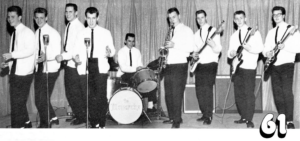 Their first professional gig paid the entire nine-member band just $20. Today, they command more than 150 times that amount—but back then, that $20 felt like a breakthrough.
They knew they were moving up in the world when they bought a red ’49 Packard ambulance to haul their equipment. These days, it takes two 5-ton vans. That alone tells you something: The Monarchs have come a long way.
It all started in 1960 with a five-piece group called the Blue Angels—the core that would soon become The Monarchs. After adding four more members and adopting a new name (suggested by Frances Gibson, mother of lead singer Mike Gibson), the band scraped together enough money to record their first 45.
The Rise of a Local Phenomenon
This was the golden age of local music—sock hops, teen clubs, and AM radio ruled the scene. If you had a record, you had a shot.
The Monarchs took that shot in 1962 with “Over The Mountain.” It climbed into the local Top 10 and turned the band into a must-have act for teen dances across the region. Not long after, they were signed by the SAMBO Agency (later Triangle Talent), and things started moving fast.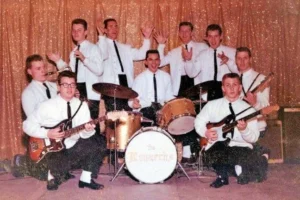
Their next release—a lively version of James Brown’s “This Old Heart,” backed with the heartfelt ballad “Till I Hear It From You” (written by Louisville’s own Charles Woodring)—helped define their signature sound. Released on the JAM label, it shot to the top of both WAKY and WKLO charts.
By the spring of 1963, The Monarchs weren’t just local favorites—they were a regional sensation.
The Soundtrack of a Generation
They became regulars at legendary venues like the FOP Hop in Okolona, the Middletown Hop, Gypsy Village at Fontaine Ferry Park, and dances aboard the Belle of Louisville. Their schedule stretched across a growing circuit—from college events to clubs throughout Kentucky and Indiana. From Indianapolis to Cincinnati, demand was constant.
What made them special?
They had range.
Their smooth harmonies and heartfelt ballads made them heartthrobs to young fans, while their clean-cut image earned the approval of even the most watchful parents. They were, in every sense, the perfect “boy next door” band—with a sound that could fill a dance floor.
The Result
- A #1 hit across local and regional charts.
- A 13-week run on the Billboard Hot 100.
- A peak at #47 nationally.
- And just like that, The Monarchs stepped onto the national stage.
On the Road
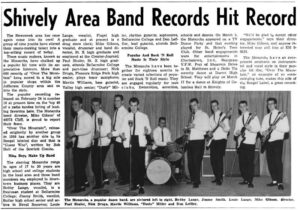 With success came the road.
The Monarchs traveled the East Coast, performing everywhere from teen dances to major grand openings. They made appearances on radio and television—including The Bob Braun Show—winning over new audiences with every stop.
“Look Homeward Angel” climbed to #1 in 17 major markets and cracked the Top 10 across the country.
They also shared the stage with some of the biggest names of the era—Del Shannon, Jay and the Americans, The Beach Boys, Glen Campbell, Bo Diddley, Johnny Tillotson, and Dee Dee Sharp.
Changing Times
Their follow-up single, “Climb Every Mountain,” performed well regionally, reaching #13. But the music world was shifting. The British Invasion was changing the sound of popular music—and life was changing for the band as well.
Members began moving in new directions. College, military service, careers, marriage, and family responsibilities gradually pulled them away from the stage.
While many groups adapted to new trends, The Monarchs stayed true to their harmony-driven style. But by the late 1960s, the original era of the band had come to a close.
A Legacy That Lasts
Their time in the spotlight may have faded, but what they built never disappeared. Because long after the shows ended and the amps went quiet, one thing remained—
They weren’t just a band.
They were The Monarchs.
And in Louisville’s music history, that still means something.